Wednesday, September 23, 2026

Pressing Matters

In the spring of 2024, as I was working my way through Bernadette Banner's catalogue of YouTube videos on sewing, costuming, and fashion history, I came to one on ironing. Banner's videos are usually more entertaining than practical for me. I love seeing the beautiful, creative things that she makes, but I'm not into costuming or historical sewing practices myself, and I am a reasonably good sewer and don't tend to learn much from watching her sew. But I'm not as good with an iron as I should be, and at that time my only ironing tools were a thin cotton handkerchief that I used as a press cloth, and a hand towel that I would roll and/or fold into whatever shape I needed to support the seam I needed to iron. For that ironing video I took notes as I watched. By the time I reached the end of the video, I had learned more advanced techniques for seam pressing and decided I really ought to get a tailor's ham, a tailor's clapper/pressing block, and a clothes brush. 

As of this writing, tailor's hams are $32.79 plus tax at Fabricland, with sleeve hams priced at $29.49 plus tax. While I'd often lingered over them when I saw them, I had never bought any sewing hams. The video mentioned that one could make one's own tailor's hams, something I'd never thought of doing, so I searched online for instructions on how to do that. I soon came across an excellent and comprehensive tutorial with accompanying free downloadable patterns from Twig + Tale. The tutorial explains which fabric and stuffing is best for such a project, and the patterns include not only the traditional ham shape but also a pattern for a sleeve ham, or sausage. I had everything I really needed to make a tailor's ham and sausage: patterns, remnant fabrics, and polyfil. However, the tutorial said that while there are various options for stuffing hams, the best stuffing for a tailor's ham is sawdust as it won't compress over time. 

I had no sawdust, but I knew someone who did. My father is an award-winning woodworker and also, as anyone who routinely works with wood must be, a prolific sawdust producer. I told him I knew what I wanted him to make me for my birthday in August 2024: a bag of sawdust. Dad had one of his knees replaced in the October 2024 and the second one replaced in the April 2024, so I asked him if he thought he was feeling up to such a strenuous and challenging woodworking project. I didn't want him to overexert himself. He modestly assured me that he thought he could handle it.    

I had initially expected that Dad would simply sweep up some of the sawdust he produces during the course of his regular woodworking activities and pour it into a bag for me, but Dad didn't think that would do at all. He took this sawdust request just as seriously as he takes all his woodworking projects, which is to say, very, very seriously. Dad asked me how much sawdust I wanted, and I said, "One grocery shopping bag full." He asked me how finely ground I wanted the sawdust, and I said,"Uh, medium I think." He asked me what kind of wood I wanted and I said I didn't think that mattered. He spoke to me about it several times during our phone calls over the following months, and mentioned that he'd gotten my sister-in-law to research sawdust stuffing online for him. 


When my parents and sister came to Swan's End for my birthday lunch in August 2024, I was presented with a brown paper yard waste bag containing all of the sawdust you see above. When I protested that I had only wanted one grocery store bag full, Dad said he had wanted to give me different grades of sawdust made from different kinds of wood, and that I could dump whatever I didn't use on the garden.  

Given my father's overperformance on the assignment, and how special this sawdust was, I felt that I needed to make more than one set of tailor's hams. I made a list of all the people I knew who sewed and might want a set: me, my sister Alanna, my sister-in-law, and my friends Christine, Lindsie, and Una. I did ask my mother if she wanted a set, but she said no, as she isn't sewing new things very often anymore, and mostly just does alterations and mending.


In November 2024, I made my first set of hams. The Twig + Tale article says that while hams have traditionally been made with one wool fabric on one side and cotton on the other, making the entire ham out of wool is even better, so I used some brown wool remnants I had on hand to make this first set which was supposed to be for me. 

I can't say I actually enjoyed making these tailor's hams. The process of stuffing them turned out to be frustratingly slow, tedious, and messy. I experimented with different methods of getting the sawdust into the ham in the hope of streamlining the process, such as a plastic funnel from the kitchen and then a larger funnel made from a sheet of paper, but I can only say that the most effective tool of any I tried was a tablespoon. Spooning the sawdust into the hams was still slow, but at least it was faster and neater than using my fingers.  


After I'd finished the first hams, I realized that my ironing equipment upgrade really ought to include a new ironing board cover. The green-striped cover you see above was one I'd bought circa 2011. It had gotten very grubby and stained over the years as it wasn't washable, and the elastic was shot, so the cover would no longer stay in place. 


I dissected the old ironing board cover and salvaged what I could. The cover fabric, foam layer, and elastic all went into the garbage, but the fleece layer was still in decent shape, and I put the plastic fastening clip in my bag of fasteners and clips for some future use.


 I washed the old fleece layer and sewed it back together for reuse with the new cover. 


When making the new cover, I stitched together a bunch of short pieces of elastic that had been my bag of elastics. It was a good way to use those up, and saved my longer pieces for projects where having a continuous piece of elastic would actually matter. Yes, that is a diaper pin you see attached to the one end. I snitched that pin from my mother's sewing notions as a teenager, and I think it might just date from my own diaper-wearing days circa 1973-1976. It's very useful as a sewing notion. The sliding cap keeps the pin from coming open when I'm trying to push it through a casing, something ordinary safety pins are all too prone to doing. 


The new ironing board cover. I purchased a length of light spring green cotton print fabric for this purpose, one that would work with my attic workroom's colour scheme, which is "neutral with accents of robin's egg blue and spring green". Then when I found that the new ironing board cover took just under half the width of the fabric to make, I made a second identical cover. There was no point in leaving that extra fabric sitting around indefinitely, and two covers made at the same time and used in tandem will last just as long as two made and used consecutively. I'm so glad I did, because I've really been enjoying having two ironing board covers. Whenever the cover I am using gets to the point of needing a wash, I can throw it in the laundry hamper and pop the fresh one immediately rather than having to schedule the laundering of a single cover in such a way that it doesn't interfere with my sewing activities. I did not tack the fleece layer to either of the new cotton covers so that it could be used with both covers.  

I used a tutorial to make the new ironing board cover, and ordinarily I would link to it as it's my practice to give credit to any other person's work that I use in the process of my own, but I recently lost all my internet bookmarks when my laptop died and I had to get a replacement secondhand laptop. I can't find the ironing board cover tutorial I used now. But it's probably just as well. When I tried to find the tutorial I used, I found a lot of ironing board cover tutorials that offered higher-level instructions. For instance, there was no mention of any batting layer in the one I used, and an ironing board cover really ought to have some padding. I wish I'd done more research before picking a tutorial for this project. However, the two basic covers that I made are certainly adequate and usable when used with the fleece underlayer from the old cover. They should also last longer than the commercially made one I had before, as they can be machine washed and the batting layer and elastic can be replaced as needed. 


My iron and ironing board were a Christmas present from my mother in the late nineties. I still remember seeing the wrapped ironing board propped behind the wall behind the tree when I got to my parents' place on Christmas Eve that year. Mum had tried to disguise the content of her gift by squaring off the wrapping paper at the pointed end, but one might as well try to gift wrap a hockey stick. I took one look at it and said, "Thanks for the ironing board, Mother," and she said, "You don't know that it's an ironing board! Multi-mixers come in very strange shapes these days!

I accidentally knocked the iron off the board some years back, and wound up with a broken iron and a dented parquet floor. I glued the plastic housing for the iron back together. The glued pieces occasionally come apart and have to be reglued, which is a pain, and I would love to get a new one, but that would be wasteful when this iron works as well as ever. I'm going to keep using it until it dies.   


In May of 2025, when I was to see my friend Christine for her birthday lunch and hadn't gotten around to making her set, I gave her the brown wool set that I had intended should be mine. 

In the summer of 2026, I finally made the remaining five sets of hams. I didn't have enough wool remnants on hand to make the hams entirely out of wool, so I made the five sets in the traditional way, with wool and cotton fabrics. My set is pictured above, with brown wool on one side and a spring green cotton print on the other. The green print is not the same as the one on the ironing board but rather a different remnant, some of which I had already used to make the English paper pieced pincushion you see on the ironing board. It is nice to have a coordinated set.  


This is the set of hams I made for my sister Alanna, out of a cotton print remnant I had leftover from a jumpsuit I made for my honorary niece and the felted pieces of a thrift shop sweater I had actually bought as a gift for my mother and that shrank when I machine washed it in cold water. I'm still very cross about that sweater shrinkage incident. (I had bought a coordinating silk scarf for that sweater!) But since it had happened and couldn't be helped, I made lemonade out of that lemon or, um, ham and sausage out of that pig. The two fabrics coordinated so well that I think this set of hams is the cutest of the six sets I've made. 


This is the set of hams for my friend Una. Una loves purple, and for this set, I used some purple cotton fabric leftover from my mask-making efforts from the early 2020s and another felted thrift shop sweater, though in this case I bought the sweater with the intention of felting it. I'd previously made her a pincushion and a tissue case in that same purple fabric. I can hardly wait to give these things to her.


Ham and sausage set numbers five and six, which are intended for Lindsie and my sister-in-law. Lindsie actually has a pincushion made from this birds and tree branch fabric, and she went on about how much she loved the fabric when I gave it to her, making it a good choice for her ham. I'm pretty sure my sister-in-law will like her set of hams too. The print is attractive, and accords well with the brown wool. Just to be on the safe side, when I give them to my SIL, I am going to tell her that if she doesn't think she'll use them, to feel free to give them away to one of her friends who sew. 

When I had finished stuffing the sixth set, I had one grocery shopping bagful of sawdust left. Dad gave me at least seven times as much sawdust as I needed. I can't think of a stuffing-related purpose for the remaining sawdust, but I'm going to keep the bag on hand for the present. I might use it on the garden next summer if nothing else arises.  


Once I had the hams all made, I bought a clothes brush and a set of tailor's clappers. My initial plan was to ask my dad to make me a pressing block. As a first step in this process, I looked at the commercially available pressing blocks online in order to decide on the design specifications that I would give to my father because, as you may have gathered from the whole sawdust production scenario, my father is a woodworker who needs detailed plans for his projects. But when I found this set of clappers for under $24, I wound up buying them. 

My father is 88 and has been in palliative care for cancer since November 2024. He's still working in his shop nearly every day, but his progress is slow and he has so many projects already on the go and more in mind. I rather hated to add to that list, I didn't know when or if he'd ever get the pressing block done, and I was impatient to get and use it for my sewing projects. Dad also would be highly unlikely to ever make me a roller-style clapper, and it would be so very useful. Block-style clappers can only be used on flat seams, while a roller like that could do curved seams. The point turner tools would be handy too. And how cute is that little sewing machine decorative detail?


To the set of clappers, I added a wooden spoon that was in my kitchen utensil drawer. As demonstrated in the Bernadette Banner ironing video, a wooden spoon handle can be very useful for pressing the seams on sewn tubes. 

There was no need to replace the handkerchief I use for a press cloth. The hand towel that I had been using in lieu of a tailor's ham retired to my linen closet.  


The last step in the process was to find some sort of container to hold my ironing equipment and extra ironing board cover. Keeping my ironing tools stashed in the little space at the end of the shelf by my basket of sewing patterns as I had been doing when I had fewer items was not going to work for the expanded collection. They'd be constantly falling off the shelf and behind the bookcase. My first thought was that I'd have to find some sort of decorative box at a thrift shop, but when I started thinking about what I had in the house that would do the job, I remembered I had a stack of four unused baskets sitting on my hall closet shelf. The largest, heart-shaped basket, which was another late nineties Christmas present, proved to be just the right size for this purpose. The candles and glass candle holders that used to sit on top of this bookcase (and which I had never once lit since I renovated and decorated the attic in 2012) were put away in the little candle cupboard in my kitchen for some future use, and this basket of ironing tools took their place. I iron right in front of that bookcase, and it's easy to get whatever I need from the basket.         

And that completes my ironing equipment upgrade. When I searched through my scribble notebook for the notes I took on that video before I began writing this post, I found that I also wrote down "sleeve board" and "tailor's anvil", but I don't think I'll get those unless I should happen to come across them secondhand. My sleeve ham should work nearly as well as a sleeve board, and I can probably improvise something for seams that come to a point. 

I've never liked ironing and I doubt that will change, but knowing how to iron more effectively and having better tools has made the task less difficult and frustrating, and will mean that my sewing projects will have a more professional look when finished. And I'll be sure to take at least some pleasure in using these carefully made and thoughtfully purchased tools.    

Saturday, September 12, 2026

A Manly Sweater


For my grandnephew Bug's 13th birthday, the present planning process followed its usual course. The present was going to consist of a sweater and some small fun or useful thing. 


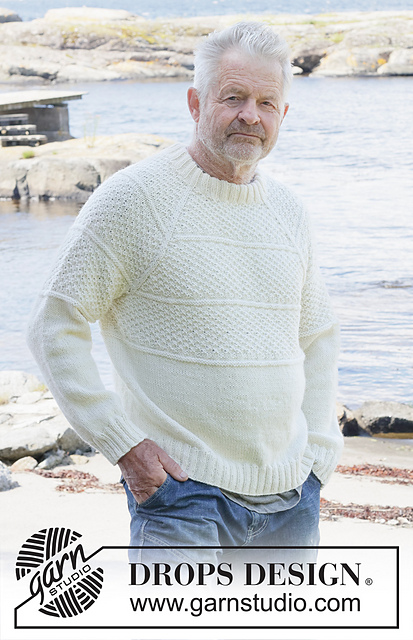
I searched Ravelry for a suitable pattern, and soon decided on the 251-2 Harbor Horizon pattern from Drops. It's clearly meant to be a take on the classic fisherman's sweater (note the shoreline background and the "old salt" type model), but could also do very well for a boy just going into the eighth grade in a landlocked Ontarian county. Such is the versatility of classic knitwear! 

As to yarn, I visited Romni Wool and bought 650 grams of Drops Karisma in Dark Grey. I wasn't crazy about the idea of an all grey sweater as I could only picture it looking rather boring and drab, but that Dark Grey was the only shade that the store had enough of in an affordably priced DK that would work for a young boy's sweater. 


The completed sweater in a men's size small. As you can see, I didn't knit an all grey sweater after all. I looked through my DK stash box to see what might work as a stripe in the neckband, cuffs, and waistband. I had some cream DK, but didn't seem to have any DK in a colour that would work with it, so I checked my fingering yarn box, and found some wine fingering that would work well if knitted double strand. I think it worked out well, and that the stripes did quite a bit to lighten, brighten, and add visual interest to this sweater while keeping the look classic. Another advantage of adding these stripes was that it cut down the cost of the project. With the addition of those contrast stash yarns, I was able to complete this pullover with only twelve of the thirteen skeins I had bought. The thirteenth skein can be returned for store credit, or as I like to think of it, a down payment on a future project. 

My only concern was that I had made the sweater too large. Bug is quite small for his age and I really ought to have made a size 13 or 14, not a men's size small. He will surely grow into it sooner or later, but no kid wants to wait a year or two to get to use a birthday gift.  


I usually buy the trinket part of children's gifts at the dollar store, but this year Dollarama failed me when it came to my finding something fun or cool for an adolescent boy. I tried the toy section of Walmart next, looking specifically to see if they had any science kits first, because Bug is interested in science. This inexpensive "grow a mini crystal cactus" kit seemed like something he might enjoy. 

And that was a birthday gift that hopefully hit the spot for a 13-year-old boy in terms of being fun, educational, handsome, and manly (if possibly a little too manly).  

Friday, September 11, 2026

A Seventeenth Summer Gift


Something like fifteen years ago a co-worker of mine gave me three bags of Bouquet Sock & Sweater yarn in blue, gray, and wine. I've been working on using the yarn up ever since. So far I've made a pullover for each of my friend Christine's two sons, a sweater for Cauliflower's younger brother Bug, and a pair of gray socks for me. I also gave my mother enough of the gray yarn to make three pairs of men's socks after she told me she wanted some sock yarn to make socks for my father, and used the three yarns to crochet the Sherlock doll I made for my sister for Christmas one year. There may have been a few other little projects that I don't remember now. And yet... I had plenty left. Those three lots of yarn seem inexhaustible, or at least determined to exhaust me. In late 2025, when I was planning my 2026 knitting projects, I decided I had enough of those three yarns left to make a sweater for my grandniece Cauliflower's seventeenth birthday this summer. 


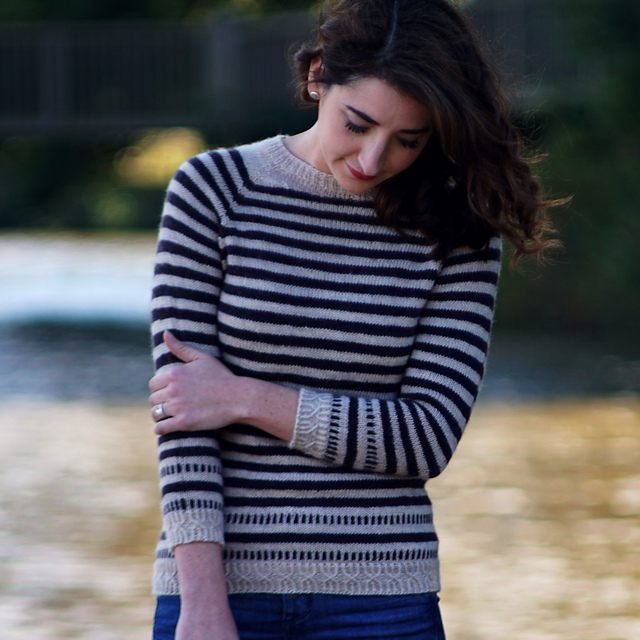
I searched Ravelry for a suitable pattern and soon selected the pattern you see above, which is Belleville by Christina Danaee. It's so nicely detailed with such a smart look to it, and it's a free pattern. 


The finished sweater. I made just one modification to it, which was to make the sleeves full length rather than cropped. I don't like cropped length sleeves myself, and while I don't know whether Cauliflower feels the same way, full length is the safe, classic choice. 

It took way longer to knit than it should have. First I had gauge issues, as the pattern suggests a range of needle sizes to use rather than specifying one. I did swatch, and still made the wrong choice in needle. Then once I had that sorted out, I was afraid I wouldn't have quite enough of the blue and wine yarns to make it in two colours, so I began knitting it with the idea that the yoke and the hem would be in gray. But after getting nearly down to the arm holes, I decided I would have enough yarn to do it in two colours and that it would look better that way, so I began again. Then, after I had nearly finished the body, I realized I hadn't added enough stitches when I separated the body from the sleeves, and had to rip the body all out and redo it. I'm so tired all the time that I make a lot of stupid mistakes like that in everything I do, and then I have to spend more time and energy working to fix the errors, which makes me more tired. (Thanks, chronic fatigue issues!) This sweater should have taken one month, and took two. But it finally got done, and I was very pleased with it. 

I did have more than enough yarn to knit it with, and I still have a total of 171 grams of the three yarns left, enough to make a child's sweater. Which I will probably do at some point, because I remain determined to use it all up. IT'S YOU OR ME, YARN.  


For the trinket part of the gift, I bought a bottle of vanilla body spray from Dollarama. Not a bad birthday present for a seventeen-year-old girl, especially for under $6. 

My mother keeps telling me that Cauliflower prefers to pick out her own clothes and that I should just give her money for her birthday and Christmas, but the thing is I often put Cauliflower's gifts together at such a low cost that the monetary equivalent would mean nothing to her, and it's better for me to prepare a gift for her than to say, "Happy birthday, Cauliflower, here's your six bucks! Go nuts!" And while I'm trying to bear in mind that as a crone of 53, I am almost certainly hopelessly out of touch with what teenagers like these days, I honestly don't see what even the pickiest teenage girl could find to object to about this sweater, unless she's into some sort of specific subculture style like goth or punk, and Cauliflower isn't. Her tastes seem to be very mainstream and generic, even normcore.  

Anyway, this birthday gift has already been relayed to Cauliflower, and it's time for me to see what I can scare up for her Christmas present. 

Thursday, September 10, 2026

A Sparkling Birthday Present

In May 2026, my honorary niece Olivia turned 10. And of course there was a gift to mark the occasion, one that followed my usual gift formula of "something to wear, something to do, and something to read". Or more accurately in this case, "things to wear, things to do, and things to read".


 McCall's M8619 | McCall's Sewing Pattern Girls' Ruched Dress, Top and Skirt | Front of Envelope

Let's start with the things to wear. Olivia's mother Lindsie told me last fall that "Olivia isn't so into dresses at present", so I selected the top and skirt pattern you see above, McCalls M8619. If made in the same fabric, they'd have the effect of a dress, but could also be worn separately with other things from Olivia's wardrobe. Olivia should be able to get more wear out of them than she would out of a dress. 

As to fabric, in January 2026, I went to Fabricland that was closing out and bought a cotton print of white stars on a red fabric for a little over $3 a metre, which is rock bottom pricing for new fabric these days. It was actually a Christmas decor fabric, but I told myself it could pass for a bright, fun summer print. 


The completed outfit in a size 10. It's a pretty cute summer outfit, and the skirt has pockets. 

Next came the matching purse.


I usually make Olivia's purses out of leftover fabric, and sometimes I knit them, but for this purse-making occasion I happened to have a little clasp purse on hand that was in need of a makeover. I bought the clasp purse you see above years ago at a dollar store for about $3, and it was ever so cute, but it got stained while sitting next to a brown vinyl bag on the shelf in my closet, and I wasn't able to remove the brown marks. After some profanity and gnashing of teeth, I put it aside figuring I'd redo it for myself at some point, but then when I was planning Olivia's birthday outfit, it occurred to me I didn't really need it and would rather do it over for Olivia. Lindsie tells me Olivia has kept all of the purses I've made for her, and Olivia is one to take excellent care of her things, so I thought it was a good idea to make a purse she could really grow up to and use as an adult. 


I didn't want to use the cotton print to make the purse, as it seemed like a bit too much visually. I had some remnants of red velvet and red bridal satin on hand that both went together and went with the red cotton print, so I used those for the purse. I did consider using the cotton print for the lining, but thought it better to make a solid red purse that would work with other things. 


I took the purse apart, reused the frame and the cardboard form, and used the old orange vinyl fabric as a pattern for making the new purse. The old purse was a no-sew bag put together with glue, but I did a little sewing for my version, overcasting the edges of the fabrics to prevent fraying, and stitching the end pieces together.


The resulting purse turned out quite well for something made out of an old ruined bag and remnant fabrics.


Then I couldn't resist making a necklace to complete this young lady's outfit. I tried to put something together out of the red and white beads I had in my jewelry supply box, but couldn't seem to find a combination that worked. I wound up buying a string of red beads and a string of mother of pearl beads from Michaels, and put them with the smaller red beads and the silver tone spacer beads I had on hand. 


I think it was worth the extra cost as this is a necklace Olivia will be able to wear all the rest of her life. 


I didn't have a suitable gift box for the necklace. I thought I'd put the necklace in the purse when I wrapped the gift, and then I imagined the necklace catching on and snagging the lining, so I made a little sachet bag out of the cotton fabric, put the necklace in it, and put the sachet bag in the purse for Olivia to find.


For Olivia's seventh birthday in 2023, I made her a knitted doll and a wardrobe of seven outfits. Since then, I have been giving Olivia one doll outfit per birthday to freshen her baby's wardrobe, with the intention of ceasing to do so after Olivia's tenth birthday. Ten outfits is a good array of clothing for a doll, and Olivia will soon be too old for dolls anyway. The choice for Olivia's doll's final outfit was easy. The Raincoat outfit by Sarah Gasson, which you see above, is adorable, and how could I not make a rainy day outfit for a doll named Rainbow Sparkle Unicorn-Animals?  

I decided to make the outfit in just yellow and red, as I thought I'd prefer the look and it also cut down the expense a little. I purchased four skeins of Patons Astra for this project (three in Maize Yellow and one in Cardinal) from Michaels, using their coupons. I also had a little left of each of these two yarns in my stash: 9 grams of the yellow and 17 grams of the red.  


The completed rainy day outfit. I had some trouble finding wooden toggles for the raincoat. Eventually I settled for these, which are slightly smaller than they are supposed to be, and not quite the same style as those used in the sample photo. I adjusted the design a little to make them work. And I never did get around to looking for one of the cute doll-size toy umbrellas that are in the design's sample photo, but I suspect I wouldn't have been able to find one anyway. 


As for the rest of Olivia's gift, I bought a thrift shop copy of Out of My Mind by Sharon M. Draper, a thrift shop copy of a book on how to paint with watercolours, a box of watercolour paints, a pack of paint brushes, and a block of watercolour paper from Dollarama. I made a pretty bookmark out of an old greeting card, and put it in the novel. Then one day in June 2026 when I thought I had enough things for Olivia's birthday gift and was coming home from the grocery store, I passed a house that had an array of discarded items sitting on the edge of its front lawn for passersby to take if they wanted. One of the things on offer was a little cat cross-stitch kit in good-as-new condition. My first thought was that I didn't want it because I have so many needlework kits in the house to get to and I would have no use for the finished item, but then I thought of Olivia and how it would be the perfect counted cross-stitch starter project for her, and tucked it into my bag (along with a vegetarian cookbook and a set of five-pound handweights for me). 

Olivia loves reading, arts and crafts, and animals, so she should be able to get quite a bit of enjoyment and use out of these items. She's also a girl who likes a project, and will be able to teach herself watercolour technique and the basics of counted cross-stitch with these things. 


Not a bad array of gifts for a ten-year-old, especially given their humble and respectively handmade, madeover, upcycled, thrift shop, dollar store, clearance sale, coupon discounted, and found item origins.


I wrapped Olivia's and Rainbow's gift separately, complete with their own cards and sticking with the red and white theme, then shipped them off to her. Olivia got her birthday gift about six weeks after her actual birthday because I suck at getting things done. However, she received it on the morning of June 26th, which was her first school-free day of the summer. This wasn't such bad timing, as it was a nice way for Olivia to kick off her summer vacation. I was also glad that Olivia got her new red and white ensemble in time to wear it for any July 1st celebrations she might go to, as she would look very patriotic and like a Canada Day sparkler in it. 

Lindsie sent me photos of a very excited and happy young girl opening her present, and told me Olivia loved everything in it. Lindsie told me she herself thought the red velvet purse was beautiful and that she would love to borrow it, but that Olivia will never let her.  


I also received a bestickered thank you card from Olivia not too many days later. So, the gift turned out well even if it was late, and it was well-received. Can't ask for better than that.  

Tuesday, September 8, 2026

A Little Ooh La La


Many years ago I discovered Joan McGowan-Michael's fabulous lingerie-inspired knitting designs, and in particular her pattern for thigh-high stockings. 


I think I've been aware of McGowan-Michael's Marlaina Thigh-High Stockings design since shortly after it was published in 2009, and I have longed to make them since I first saw them. They're so satisfyingly quaint, beautiful, romantic, and a little ooh la la. I love historical fashions, but I'm no Bernadette Banner. My style runs to the simple and sensible, and isn't at all costumey. It isn't often I can find a way to incorporate historical fashions or historically inspired elements into my wardrobe, but it seemed to me that these stockings were very wearable. I firmly intended to make them for several years. Then I started becoming more practical and realistic about my project planning, and I asked myself what these stockings would go with in my wardrobe. I couldn't seem to come up with a colour that would work with my existing clothes. (I think I was limiting my thinking to the colour selection of the kits available for this project: Cranberry, Charcoal, and Ivory.) I decided I wouldn't wear them, and regretfully struck them from my project list. Then a few years ago I realized that if I were to make these stockings in a dark brown, they would work with plenty of my skirts and dresses, and they went back on my knitting list. 

It did feel a little on the drearily practical side to knit stockings like this in brown. But it works for me, and while dark chocolate brown may not seem like the most exciting or sexy colour to others, I've come to love it. It's such a warm, rich shade, and it's flattering to me, unlike black, which makes me look like a hag.


I purchased two skeins of Pro Lana Sockenwolle Melange in brown, and knitted the stockings in size Large (8-9). There were two modifications involved. I found I didn't care at all for the look of the Honeybee stitch, it would have shown more of my skin than I wanted, and I could just imagine all those loose strands constantly catching on everything every time I wore the stockings. I looked through my knitting stitch books, and wound up using a lace motif from a more complex stitch design from Hitomi Shida's Japanese Knitting Stitch Bible (#113, found on page 65). I also made the stockings 32" long (measured from the bottom of the heel to the top of the stocking) rather than the 24" the pattern calls for. I have long legs for my height, and I wanted to be able to wear the stockings with an above the knee skirt without worrying that the tops were showing. I was happy with the resulting design and fit.

But I wasn't quite satisfied with the colour of the yarn. It was a little grayish and tweedy in tone, not the dark chocolate brown I always try to buy so all my brown clothes, shoes, and accessories will work together. When I got the yarn home from Romni Wool and compared it to my dresses and skirts, I found it did go with a few of my things in my closet as was, but it would go with more things if it were darker. So I decided to dye the stockings to the shade of brown I wanted once I'd gotten them knitted, as that would be easier than trying to dye hanks of yarn.   


The stockings, and the leftover 22 grams of yarn, after dyeing. I used Rit Dye in Brown, and also put the stockings through a fixative process. I'm so much happier with the colour now. It was a time-consuming business winding the tangled partial skein into a ball after I'd dyed it, but it was worth it, as I'll be able to darn the stockings in the same colour yarn.


The only thing left to do was insert the elastic and the ribbons through the holes at the top, and then photograph the stockings. The first task was a straightforward matter. I found a large tapestry needle did the threading much faster and more easily than my fingers. I put the elasticized and beribboned stockings on and discovered the stockings had shrunk slightly in the dyeing process. They still fit width-wise, but they're 30" long instead of 32". I could rip back the lace at the top and add another two inches to the length with the leftover yarn, but I probably won't bother. They're still a very workable length on me. 

The photography shoot was another matter. I had grand plans of taking a shot of my legs in the stockings, but I discovered it's very difficult to get a good shot of one's own legs in thigh-high stockings. The images that appeared in the preview window of my digital camera when I was trying to find a good angle were so unflattering (i.e., horrifyingly large thighs and absurdly tiny feet) that I never bothered taking a shot. And it's not easy to take a nice photo of stockings just by themselves. You'll have noticed that the sample shot shows the stocking on a leg form. 

But, um, here are the stockings in a heap!


 Here's a shot of the front lace panel in the stockings. 


And here's a shot of the stockings neatly rolled. This is how I keep them in my stocking and tights drawer.

Lacklustre photography aside, I really am very satisfied with my beautiful brown thigh-high stockings, have a plan to wear them with a tartan skirt at a Scottish-themed dinner party I'm planning for January, if not earlier, and I even intend to keep my pattern print out, with its attached chart of the lace stitch I used and my notes, in my pattern library so as to be able to make a replacement pair of stockings when these wear out, or even a pair in another colour.  

Monday, September 7, 2026

The Lone Houseplant


When I hosted an Irish-themed supper party in late March 2026, my friend Lindsie, who was one of the guests, presented me with a baby aloe vera in a 2" pot upon her arrival. As she put it, "It's green."

I hadn't had houseplants at Swan's End in many years. In the condo I used to own, I had lots of thriving plants. I rather prided myself on my indoor gardening ability in those years, but the fact was my plants did so well because they got loads of light. One end of my living room was almost all window with  a southeastern exposure, which created an environment for plants that was one stop short of a greenhouse.

After five and a half years of condo life, I moved to the three-bedroom semi-detached I now own in 2006, bringing all my plants with me. Swan's End has no side windows, and mostly smallish windows at the front and the back of the house. Also, as I was now living at street level and close to a busy street with a lot of foot traffic, I preferred to keep my bedroom and living room curtains closed. Over the next few years, my plants all dwindled and died. I bought new plants, and they also died. I bought specifically low-light plants, and they died too. I came to realize that I could only have plants in a few places in the house: by the kitchen window, and in the attic casement window. In 2009, after three years of struggling with a chronic and horrifyingly severe mouse problem, I adopted my cat Trilby, who turned out to be a dedicated hunter with a voracious appetite, which was great mouse control-wise, but not so good for my plants, as he would routinely attack and eat them. A few years later, after my last houseplant died, I gave up entirely on keeping houseplants, telling myself I would have to content myself with outdoor gardening in the summer. Sometimes I would start bulbs in the attic window in late winter, keeping the door to the attic shut so Trilby could not molest them, but that was all.   

And now, in 2026, I had a plant again. I was glad to get it. Aloe veras are useful for first-aid and cosmetic purposes, and I could keep it by the kitchen window without fear, as since September 2021, Trilby has been in his resting place underneath the apricot tree in the back garden, where he loved to play and try to catch birds and butterflies. 

I very soon got on the job of repotting the aloe vera, because the tiny flowerpot it came in had no drainage holes and was just intended to be temporary. I checked to see if the old cupboard in the lean-to had any 4" pots. I had just one, a thin plastic number of the type that comes with a new plant. My self-watering pots were all 6" or larger. I repotted the aloe vera into the 4" pot I had, but soon found I didn't like having to water it daily. I did some internet searches to see where I could buy a 4" self-watering pot, and could only find some I didn't like or that had to be bought in lots of five. Then it occurred to me that perhaps I could rig up a self-watering mechanism for the aloe vera, using materials I had around the house.


This was my first attempt at creating a self-watering pot. I don't usually buy pop, but I had bought one bottle of club soda to make pitchers of Emerald Isle Mocktail for my Irish supper party, so I did some surgery on it once it was empty. It was utilitarian, but I didn't care for the look of it. I also used kitchen twine for the wick, which worked after a fashion but was not ideal. The soil was clearly getting some water via the twine, but always looked a little on the dry side to me. I decided I needed to upgrade the wick, and also wanted to find a way to use my favourite flowerpot, a 6" enamelled number I'd bought at a thrift shop years before. 


Cotton is supposed to be the best fibre for self-watering wicks, as it's very absorbent. I had cotton yarn in my stash, and used 10 grams of it to knit an 8" I-cord for the wick. This was definitely my fastest and easiest knitting project of the year. It may also have been the most genuinely useful.  


To thread the wick through the soil, I stuck a crochet hook down into the aloe vera pot until it emerged from one of the drainage holes, hooked one end of the knitted wick onto the crochet hook, and pulled the wick up through the pot until it was just below the surface of the soil. 

I put an old margarine tub in the flowerpot, which protected the metal flowerpot from rusting away and created a reservoir for the water. Then I just needed a way to keep the aloe vera pot above the waterline. A rock from the garden served the purpose.


This is a photo of the aloe vera as of September 7th, 2026. As you can see if you compare it to the older photos of it above, it has grown quite a bit in just over five months, and it looks healthy and happy. I think it should be ready to graduate to one of my 6" self-watering pots by its first birthday. I'll still get to use this enamelled flowerpot, as the 6" self-watering pot will fit inside it.   

And I'd say something about how I now have renewed faith in my gardening abilities if I weren't afraid my woefully neglected front and back gardens would respond by staging some sort of vengeful Day of the Triffids-style attack on the house.